Overview of Clinical Risk Calculators in Biogistry
Hereditary cancer screening, reproductive counseling, and medical genetics consultations rely on accurate disease risk quantification. Modern clinical practice requires evaluating complex multi-generational family health histories against validated risk assessment algorithms, Bayesian penetrance tables, and clinical referral thresholds. However, traditional risk assessment workflows suffer from significant friction. Healthcare providers must manually re-enter patient data across disconnected software tools, rekey diagnostic codes into standalone web forms, or rely on opaque black box calculations that lack verifiable audit trails.
Biogistry solves these challenges by providing 17 validated clinical risk models, Bayesian peeling algorithms, and National Comprehensive Cancer Network (NCCN) guideline referral rules in a single integrated workbench. Built directly into the Biogistry pedigree workspace, our risk calculation suite automatically reads patient demographics, clinical diagnoses, surgical histories, and molecular test results from the active family pedigree tree.
Clinical geneticists, genetic counselors, oncologists, and health system researchers can run complex risk evaluations instantaneously. Every calculation executes locally inside your workstation's web browser memory. No patient identifiers, clinical records, or pedigree trees are uploaded to external cloud servers. This architecture ensures complete compliance with HIPAA and GDPR data privacy regulations while delivering zero network calculation latency.
Nothing is a Black Box: Transparent Math, Formulas, and Step-by-Step Audit Logs
In clinical genetics, an unverified risk score creates diagnostic uncertainty, increases legal compliance risks, and reduces physician confidence during multidisciplinary tumor board reviews. Clinicians must understand how a patient's personal and family history translates into a specific numeric risk percentage. Biogistry eliminates black box calculations by generating a transparent math audit receipt for every risk score and calculation engine.
Interactive Step-by-Step Calculation Receipts
Whenever a risk model evaluates a patient on the active pedigree canvas, Biogistry generates a detailed interactive calculation receipt. Clicking any summary risk percentage or referral flag opens an inspection drawer containing complete calculation provenance:
- Input Parameter Tracing: Lists every clinical data element extracted from the patient pedigree node. Parameters include exact current age, age at menarche, age at first live birth, prior breast biopsy count, histologic findings, specific relative relationship degrees, ages of cancer onset, and documented germline testing results.
- Intermediate Likelihood Ratios: Provides total visibility into Bayesian calculation steps. Clinicians can inspect baseline prior probabilities, age-dependent penetrance values, conditional likelihoods for unaffected relatives, and joint probability products across generations.
- Demographic Hazard Rate Matching: Displays baseline population cancer incidence rates derived from Surveillance, Epidemiology, and End Results (SEER) tables and age-specific mortality hazard rates applied to competing risk equations.
- Relative Risk Multipliers: Shows individual risk factor weights, including relative risk ratios for first-degree family history, early menarche, and atypical hyperplasia.
- Reference Standard Citations: Includes explicit bibliographic citations for primary peer-reviewed journal papers, published equations, baseline hazard tables, and NCCN guideline criteria versions.
Clinicians can copy, print, or attach the complete audit log directly to patient electronic health records (EHR), consultation summaries, or academic publication figures.
In-Depth Breakdown of 17 Validated Risk Engines and Calculation Tools
Biogistry integrates 17 validated clinical risk models, Bayesian graph peeling engines, and guideline referral calculators:
1. Gail Model (BCRAT) Invasive Breast Cancer Risk Assessment
The Gail Model, also known as the Breast Cancer Risk Assessment Tool (BCRAT), estimates a woman's cumulative probability of developing invasive breast cancer over a 5-year period and over her total lifetime up to age 90.
- Clinical Purpose: Identifies women at elevated risk for invasive breast cancer who may benefit from enhanced screening protocols, such as annual supplemental breast MRI, or risk-reducing chemoprevention agents like selective estrogen receptor modulators.
- Pedigree Inputs: Patient current age, age at menarche, age at first live birth, number of first-degree female relatives (mother, sisters, daughters) diagnosed with breast cancer, total number of previous benign breast biopsies, and presence of atypical hyperplasia on biopsy.
- Calculated Outputs: 5-year cumulative invasive breast cancer risk percentage, lifetime cumulative risk percentage, and comparison risk scores for an average American woman of the same age and race.
- Primary Publications: Gail et al., Journal of the National Cancer Institute (1989); Costantino et al., Journal of the National Cancer Institute (1999).
2. Claus Model for Familial Breast Cancer Risk Assessment
The Claus Model evaluates cumulative breast cancer risk for women based on detailed family history patterns of breast cancer in first-degree and second-degree female relatives, taking into account specific onset ages.
- Clinical Purpose: Assesses breast cancer risk in families with multiple affected relatives where high-penetrance germline testing (such as BRCA1 or BRCA2) is negative, inconclusive, or unavailable.
- Pedigree Inputs: Patient current age, ages of breast cancer onset in first-degree relatives (mother, sisters, daughters) and second-degree relatives (maternal and paternal grandmothers, aunts).
- Calculated Outputs: Cumulative decade-by-decade risk percentages for developing breast cancer from current age up to age 79.
- Primary Publications: Claus et al., Cancer (1994).
3. Lynch Syndrome Mismatch Repair Gene Risk Assessor (Kastrinos et al., 2017)
This calculation engine independently estimates the overall cumulative probability that an individual carries a germline pathogenic variant in one of the five Lynch syndrome predisposition genes: MLH1, MSH2, MSH6, PMS2, or EPCAM.
- Clinical Purpose: Evaluates patient eligibility for comprehensive germline multigene panel testing for Lynch syndrome and guides clinical triage for colorectal and endometrial cancer risk management.
- Pedigree Inputs: Patient sex, personal history of Lynch syndrome-associated cancers (colorectal, endometrial, ovarian, gastric, small bowel, urinary tract, brain, sebaceous adenomas, or pancreatic cancer) and onset ages, plus family history of Lynch cancers in first-degree and second-degree relatives.
- Calculated Outputs: Overall percentage probability of carrying a mismatch repair gene mutation, individual gene-specific carrier probabilities, and indication flag for recommended genetic testing (threshold at 2.5 percent or higher).
- Primary Publications: Kastrinos et al., Journal of Clinical Oncology (2017).
- Scientific Methodology and Trademark Disclaimer: This calculator independently implements the statistical prediction model and coefficients published by Kastrinos et al. in the Journal of Clinical Oncology (2017). PREMM5 is a registered service mark of the Dana-Farber Cancer Institute. This software is an independent implementation of the published statistical coefficients and is not affiliated with, sponsored by, or endorsed by the Dana-Farber Cancer Institute.
4. Ovarian Cancer Risk Model (BOADICEA / BRCAPRO Framework)
This risk calculator estimates cumulative lifetime and age-specific risk for epithelial ovarian, fallopian tube, and primary peritoneal cancers based on germline mutation status and multi-generational family history.
- Clinical Purpose: Guides clinical decision-making regarding risk-reducing salpingo-oophorectomy (RRSO), pelvic ultrasound screening, and CA-125 serum marker monitoring in high-risk hereditary cancer families.
- Pedigree Inputs: BRCA1, BRCA2, RAD51C, RAD51D, and BRIP1 genetic test results, personal and family history of ovarian and breast cancers, relative onset ages, and prophylactic surgery history.
- Calculated Outputs: Remaining lifetime ovarian cancer risk percentage and decade-by-decade age-specific cumulative risk tables.
- Primary Publications: Antoniou et al., British Journal of Cancer (2004).
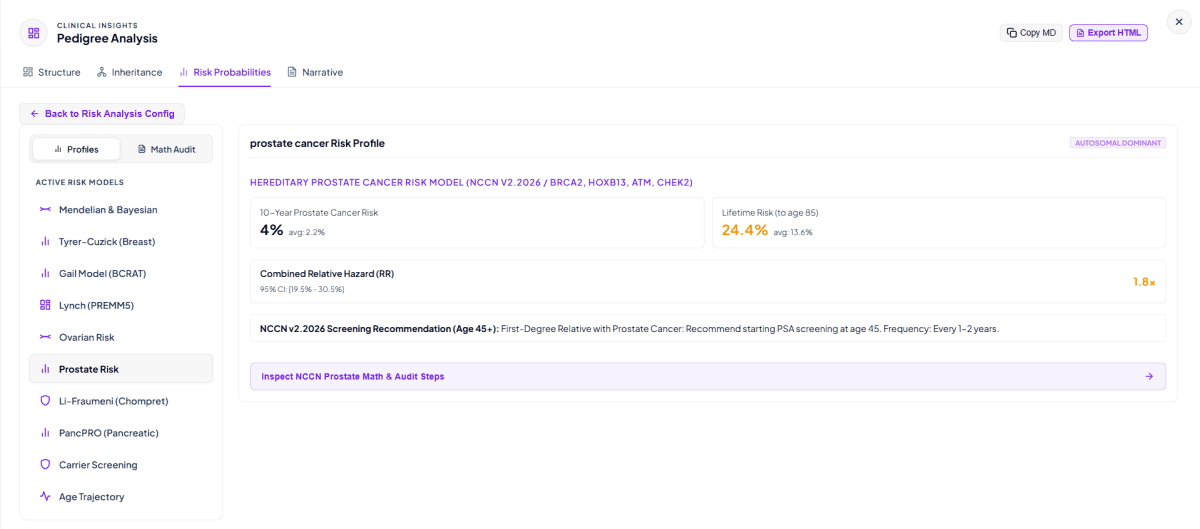
5. ProstatePro Familial Prostate Cancer Risk Calculator
ProstatePro estimates lifetime and age-specific risk of aggressive prostate cancer based on multi-generational family history, relative onset ages, and documented germline mutation status.
- Clinical Purpose: Informs early PSA screening initiation, magnetic resonance imaging (MRI) surveillance, and targeted germline testing for men with familial prostate cancer clusters.
- Pedigree Inputs: Personal and family history of prostate cancer, Gleason scores, age at diagnosis in first-degree and second-degree male relatives, HOXB13 mutation status, and mismatch repair gene status.
- Calculated Outputs: 5-year, 10-year, and lifetime risk percentages for aggressive prostate cancer compared to age-matched population baselines.
- Primary Publications: Chen et al., European Urology (2020).
6. PancPRO Pancreatic Cancer Familial Risk Model
PancPRO calculates the individual probability that a person carries a familial pancreatic cancer susceptibility gene and estimates 5-year and 10-year risk of developing pancreatic ductal adenocarcinoma.
- Clinical Purpose: Selects candidates for high-risk pancreatic surveillance programs using endoscopic ultrasound (EUS) and magnetic resonance cholangiopancreatography (MRCP).
- Pedigree Inputs: Personal and family history of pancreatic cancer, age of onset in relatives, personal smoking history, history of chronic pancreatitis, and germline mutation status in CDKN2A, BRCA2, PALB2, STK11, or mismatch repair genes.
- Calculated Outputs: Carrier probability for high-penetrance pancreatic cancer genes, 5-year pancreatic cancer risk percentage, and 10-year cumulative risk percentage.
- Primary Publications: Wang et al., Cancer Research (2007).
7. Chompret Criteria Evaluator for Li-Fraumeni Syndrome
Evaluates multi-generational family pedigree patterns against updated international Chompret criteria to calculate carrier probabilities for germline TP53 pathogenic variants.
- Clinical Purpose: Identifies individuals affected by or at risk for Li-Fraumeni syndrome to trigger annual whole-body MRI screening, brain MRI, and targeted pediatric surveillance.
- Pedigree Inputs: Personal history of Li-Fraumeni core tumors (sarcoma, breast cancer, brain tumor, adrenocortical carcinoma, leukemia, or bronchoalveolar carcinoma) diagnosed before age 46, multiple primary tumors, and family history of core tumors.
- Calculated Outputs: Automated Chompret criteria fulfillment flag (Criteria 1, 2, or 3) and TP53 germline carrier probability score.
- Primary Publications: Bougeard et al., Journal of Clinical Oncology (2015).
8. Expanded Carrier Screening Calculator
Computes joint reproductive risk for couples undergoing preconception or prenatal genetic evaluations across more than 250 autosomal recessive and X-linked conditions.
- Clinical Purpose: Identifies carrier-couple status to inform reproductive choices, pre-implantation genetic testing (PGT-M), prenatal diagnostic sampling (CVS or amniocentesis), or newborn specialty care.
- Pedigree Inputs: Maternal and paternal carrier screening variant panel results, variant pathogenicity classifications, and ethnic background carrier frequency baselines.
- Calculated Outputs: Condition-specific offspring risk percentages (such as 25 percent for autosomal recessive carrier couples) and overall cumulative reproductive risk across all screened loci.
- Primary Guidelines: ACOG Committee Opinion Number 690, Genetics in Medicine.
9. Elston-Stewart Bayesian Peeling Algorithm
Executes exact likelihood computations across extended multi-generational pedigree graphs with complex consanguineous loops and incomplete genotype data.
- Clinical Purpose: Powers exact penetrance and carrier probability calculations across complex family trees where simple nuclear family formulas fail.
- Pedigree Inputs: Full pedigree topological graph structure, individual phenotype statuses, age at last follow-up, and partial molecular test data.
- Calculated Outputs: Genotype likelihood vectors for every un-tested individual in the extended pedigree tree.
- Primary Publications: Elston and Stewart, Human Heredity (1971).
10. Bayesian Likelihood Updater for Genetic Test Results
Dynamically updates prior genotype probabilities using age-dependent penetrance curves, unaffected relative survival ages, and negative targeted genetic test results.
- Clinical Purpose: Calculates accurate residual carrier risk for an individual who tests negative for a known familial pathogenic variant, factoring in age-dependent penetrance.
- Pedigree Inputs: Familial pathogenic variant details, patient current age, age-specific disease penetrance curve data, and negative genetic test report status.
- Calculated Outputs: Prior carrier risk percentage, conditional likelihood of remaining unaffected at current age, and updated posterior residual carrier risk percentage.
- Primary Publications: Bayes (1763); Cannings and Thompson, Sequential Sampling (1981).
11. NCCN Referral Engine v2.2026 (Breast, Ovarian, Pancreatic, Prostate)
Cross-references patient personal history and multi-generational family tree history against the National Comprehensive Cancer Network Guidelines Version 2.2026 for Genetic/Familial High-Risk Assessment.
- Clinical Purpose: Provides automated point-of-care clinical decision support to identify patients eligible for germline multigene panel testing for hereditary breast, ovarian, pancreatic, and prostate cancer syndromes.
- Pedigree Inputs: Patient diagnoses, ages at onset, pathology features (triple-negative breast cancer, lobular histology, ductal pancreatic adenocarcinoma, high-grade prostate cancer), Ashkenazi Jewish ancestry, and family relative clusters.
- Calculated Outputs: Automated NCCN referral criteria flag (Met / Not Met), specific qualifying criteria code list, and recommended gene testing panel suggestions.
- Primary Guidelines: NCCN Clinical Practice Guidelines in Oncology: Genetic/Familial High-Risk Assessment: Breast, Ovarian, Pancreatic, and Prostate (Version 2.2026).
12. NCCN Referral Engine v1.2026 (Colorectal, Endometrial, Polyposis)
Cross-references patient and family history against NCCN Guidelines Version 1.2026 for Colorectal and Endometrial High-Risk Assessment.
- Clinical Purpose: Flags indications for Lynch syndrome tumor screening (mismatch repair immunohistochemistry or microsatellite instability), germline MMR testing, and adenomatous or hamartomatous polyposis evaluations.
- Pedigree Inputs: Colorectal cancer diagnoses, endometrial cancer, onset ages, adenomatous polyp count tracking, tumor MMR IHC results (loss of MLH1, MSH2, MSH6, or PMS2), and somatic BRAF status.
- Calculated Outputs: NCCN referral qualification flags, Revised Bethesda Guidelines evaluation, and Amsterdam II criteria validation status.
- Primary Guidelines: NCCN Clinical Practice Guidelines in Oncology: Genetic/Familial High-Risk Assessment: Colorectal, Endometrial, and Polyposis (Version 1.2026).
13. Wright Inbreeding Coefficient (F) and Malecot Kinship Engine
Calculates exact inbreeding coefficients (F) and kinship coefficients (phi) for complex consanguineous unions across multi-generational family trees.
- Clinical Purpose: Quantifies autozygosity risk and autosomal recessive disease probability for offspring of consanguineous couples (such as first-cousin or second-cousin unions).
- Pedigree Inputs: Pedigree graph connectivity matrices, ancestral common ancestor paths, and consanguineous relationship links.
- Calculated Outputs: Inbreeding coefficient (F) value, kinship coefficient (phi) value, and percentage of genome expected to be homozygous by descent.
- Primary Publications: Wright, Genetics (1922); Malecot, Les Mathematiques de l'Heredite (1948).
14. Age Hazard Engine and Competing-Risk Survival Estimator
Computes age-specific disease incidence rates and conditional cumulative risk curves using competing-risk hazard frameworks.
- Clinical Purpose: Adjusts cumulative disease risk predictions for unaffected individuals based on competing mortality risks from non-cancer causes.
- Pedigree Inputs: Patient current age, gender, race-specific baseline mortality hazard tables, and specific gene mutation penetrance curves.
- Calculated Outputs: Remaining 10-year risk percentage, remaining lifetime risk percentage, and adjusted survival curve plots.
- Primary Publications: Kaplan and Meier, Journal of the American Statistical Association (1958).
15. Empirical Multifactorial Recurrence Risk Calculator
Provides empirical recurrence risks for multifactorial congenital anomalies and polygenic conditions based on relative degree of relationship and disease severity.
- Clinical Purpose: Guides genetic counseling for polygenic conditions where single-gene Mendelian models do not apply, such as congenital heart defects, neural tube defects, or cleft lip and palate.
- Pedigree Inputs: Condition classification, number of affected family members, relationship degree to proband, and severity index.
- Calculated Outputs: Empirical recurrence risk range percentages for future offspring and siblings.
- Primary Publications: Falconer, Annals of Human Genetics (1965).
16. X-Linked Recessive Transmission and Obligate Carrier Resolver
Evaluates pedigree topology to determine obligate carrier status and calculate male offspring recurrence risks for X-linked recessive disorders.
- Clinical Purpose: Identifies female obligate carriers for conditions such as Hemophilia A/B, Duchenne Muscular Dystrophy, or Fragile X syndrome, and calculates reproductive risks for future pregnancies.
- Pedigree Inputs: Family tree inheritance structure, affected male distribution, maternal grandfather status, and genetic test results.
- Calculated Outputs: Obligate carrier classification status, female posterior carrier probability, and male offspring disease recurrence percentage.
- Primary Publications: Haldane, Annals of Eugenics (1935).
17. Sandboxed Custom Risk Engine Evaluator
Allows clinical research teams to write custom risk scoring scripts using a safe JavaScript domain-specific language (DSL) executing inside isolated Web Workers with Zero-Knowledge Audit Receipts (ZKAR).
- Clinical Purpose: Enables academic research centers to implement custom institutional risk scoring formulas, experimental polygenic risk score (PRS) models, or clinical trial enrollment algorithms.
- Pedigree Inputs: Custom DSL script payload, patient pedigree node properties, and custom parameter bindings.
- Calculated Outputs: Custom score numeric output, status classification, and verifiable audit receipt.
- Documentation Note: A dedicated custom scripting documentation page details advanced DSL syntax, Web Worker isolation, and API sandbox rules.
Single Intake Architecture: Automated Pedigree Data Integration
Biogistry eliminates double data entry. Traditional risk assessment tools force genetic counselors to type the same patient data into multiple browser tabs. Biogistry solves this through a unified single-intake architecture.
Automatic Data Flow from Pedigree to Risk Workbench:
- Diagnosis Mapping: Diagnoses entered on individual person nodes (such as invasive ductal carcinoma at age 42) automatically populate Gail, Claus, BOADICEA, and NCCN calculation tables.
- Genetic Test Synchronization: Variant classifications (Pathogenic, Likely Pathogenic, VUS, Benign) entered in the pedigree inspector automatically feed Bayesian prior and posterior peeling algorithms.
- Pedigree Graph Auto-Traversal: Relationship connections (first-degree, second-degree, consanguinity loops) are traversed automatically to build family history matrices without manual counting.
- Surgical History Adjustment: Surgeries such as bilateral prophylactic mastectomy or risk-reducing oophorectomy dynamically adjust age-dependent competing hazard calculations.
Modifying a patient's age or diagnosis on the pedigree canvas instantly updates all 17 risk calculators in your workspace.
Local Data Processing Overview and HIPAA Compliance
Standard cloud-based risk calculators send sensitive patient health data over internet networks to remote cloud servers. Biogistry executes all calculations locally inside your browser memory using WebAssembly and client-side JavaScript.
Data Elements Processed Locally Per Risk Session:
| Clinical Data Category | Specific Parameters Processed | Primary Calculation Function |
|---|---|---|
| Demographics | Current age, gender assigned at birth, ethnicity, race | Baseline hazard table lookup |
| Reproductive History | Age at menarche, parity, age at first live birth, menopause age | Gail BCRAT risk score calculation |
| Histology & Pathology | Benign biopsy count, atypical hyperplasia, ER/PR/HER2 status, triple-negative flag | Gail model multipliers and NCCN criteria matching |
| Hormonal Exposures | HRT usage type, current user status, duration in years | Hormonal exposure risk adjustments |
| Family Cancer History | Relatives affected, cancer types, onset ages, degree of relationship | Claus, Lynch MMR, PancPRO, and Chompret calculations |
| Genetic Test Records | Gene tested, variant notation, ACMG classification tier, zygosity | Bayesian peeling prior and posterior updates |
| Pedigree Topology | Parent-child edges, sibling links, partner connections, consanguineous loops | Elston-Stewart peeling and Wright inbreeding (F) |
| Surgical History | Mastectomy status, oophorectomy status, colectomy status, surgery ages | Competing hazard risk modifications |
Start Running Validated Clinical Risk Calculations Today
Streamline your clinical genetics consultations with a fast, private, and comprehensive risk calculation suite. Evaluate 17 validated risk models, run Bayesian peeling algorithms, and check NCCN referral guidelines with total client-side privacy.