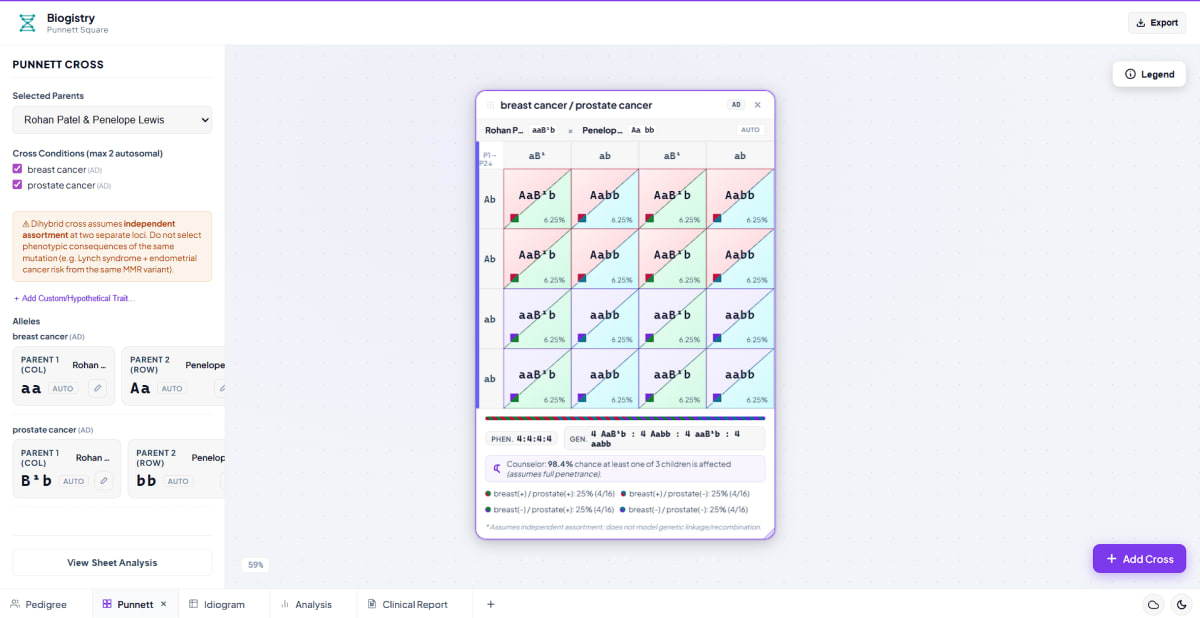
Enterprise Clinical Punnett Cross Engine Architecture
Deriving genetic recurrence risks is a core requirement in clinical genetics, reproductive counseling, and hereditary risk assessment. While paper grids are widely used in introductory education, clinical practice demands computational speed, precision across multi-locus gene interactions, non-Mendelian epistasis rules, and direct synchronization with family history pedigree charts. Manual square drawing is prone to human transcription errors when handling complex polyhybrid traits, gonosomal sex-linked inheritance, or uncertain parental genotypes.
Biogistry provides a browser-native clinical Punnett cross engine designed specifically for clinical geneticists, genetic counselors, researchers, and medical educators. Built to eliminate manual drawing mistakes, our Punnett engine reads family tree topology to construct inheritance matrices automatically. You can evaluate standard Mendelian monohybrid crosses, dihybrid multi-condition interactions, gonosomal sex-linked vectors, linked loci with recombination fractions, and Bayesian weighted carrier likelihoods in seconds.
Every cross generated in Biogistry strictly adheres to standard human genetic nomenclature as published in peer-reviewed clinical genetics journals. From standard Mendelian autosomal allele designations to HGVS cDNA variant notations, X-linked superscript formats (such as XA and Xa), variant of uncertain significance (VUS) indicators, and compound heterozygous allele tags (such as a1 and a2), our Punnett workbench generates publication-ready diagrams for patient medical records, consultation summaries, and clinical presentations.
Dynamic Interactive Punnett Cross Canvas and Box Architecture
The Biogistry Punnett workbench operates as a freeform vector canvas with smooth pan and zoom navigation. Rather than forcing static page layouts, the workspace allows clinicians to place multiple independent cross diagrams side by side on a single sheet.
Each cross is rendered inside an interactive diagram box positioned absolutely in world coordinates. You can drag boxes across the canvas, resize them to scale, or add new crosses with one click. Every diagram box displays the condition label, an inheritance mode chip, parent allele combinations, dynamic SVG grid tables, and comprehensive risk summary bars.
Key Canvas Inspector Modes
- Pedigree-Linked Mode: Automatically binds maternal and paternal slots to selected pedigree individuals, reflecting real-time updates from family tree diagnostic intake.
- Custom Hypothetical Mode: Unlinks the cross box from pedigree nodes, allowing clinicians to test hypothetical allele pairings, rare variant crosses, or educational scenarios without mutating patient chart records.
Core Cross Computation Modes: Monohybrid, Dihybrid, Sex-Linked, Mitochondrial & Bayesian Weighted
Calculating genetic crosses requires computational models tailored to specific biological mechanisms. Biogistry supports five core cross execution modes: Monohybrid Single-Locus Cross, Dihybrid Multi-Locus Cross, Sex-Linked Gonosomal Cross, Mitochondrial Inheritance Cross, and Bayesian Probabilistic Weighted Cross.
1. Monohybrid Single-Locus Cross (Mendelian Default)
The Monohybrid Cross Engine computes single-gene crosses between two parents for autosomal conditions.
- Visual Architecture: Renders a 2x2 SVG grid with two column-axis maternal gametes (P1) and two row-axis paternal gametes (P2), yielding four offspring outcome cells.
- Primary Clinical Utility: Designed for single-gene autosomal recessive (AR) conditions such as Cystic Fibrosis, Sickle Cell Anemia, or Tay-Sachs Disease, as well as autosomal dominant (AD) traits like Huntington Disease or Marfan Syndrome.
- Key Outcomes:
- Automatically calculates standard 3:1 phenotypic ratios and 1:2:1 genotypic ratios using greatest common divisor (GCD) reduction.
- Highlights baseline 25 percent recurrence risks for carrier-by-carrier autosomal recessive crosses (Aa x Aa).
- Identifies 50 percent recurrence risks for autosomal dominant crosses (Aa x aa).
2. Dihybrid Multi-Locus Cross (Multi-Condition Inheritance)
The Dihybrid Cross Engine expands grid dimensions to analyze two independent genetic loci simultaneously.
- Visual Architecture: Computes combinatorial gamete pairings (AB, Ab, aB, ab) across both parents to generate a 4x4 SVG matrix containing 16 outcome cells.
- Primary Clinical Utility: Essential for evaluating multi-condition hereditary risks, co-inherited disease traits (such as simultaneous CFTR and Lynch Syndrome carrier screening), and joint phenotype distributions.
- Key Outcomes:
- Derives dihybrid 9:3:3:1 phenotypic outcome distributions across independent loci.
- Displays combined multi-trait phenotype labels (such as CF(+) / Lynch(−)) for every outcome cell.
- Includes an automatic clinical warning reminding users that dihybrid calculations assume independent assortment on separate chromosomes.
3. Sex-Linked Gonosomal Cross (X-Linked & Y-Linked Vectors)
The Sex-Linked Gonosomal Engine incorporates sex chromosomes (X and Y) directly into parent gametes and offspring outcome matrices.
- Visual Architecture: Segregates maternal X alleles (XA, Xa) and paternal X and Y chromosomes (XA, Y). Outcome cells display explicit biological gender indicators.
- Primary Clinical Utility: Designed for X-linked recessive (XLR) conditions like Hemophilia A/B, Duchenne Muscular Dystrophy (DMD), and Fragile X Syndrome, as well as X-linked dominant (XLD) and Y-linked paternal transmission.
- Key Outcomes:
- Calculates separate recurrence risk profiles for biological sons (XY) and biological daughters (XX).
- Evaluates son-specific affected risks (50 percent of male offspring for carrier mothers XAXa).
- Demonstrates Y-linked transmission rules where only biological males inherit paternal Y-linked variants.
4. Mitochondrial Organelle Inheritance Cross
The Mitochondrial Cross Engine models non-Mendelian maternal organelle transmission.
- Visual Architecture: Identifies maternal organelle gamete vectors (mt* vs mt) and evaluates offspring risks based strictly on maternal status.
- Primary Clinical Utility: Designed for mitochondrial disorders such as Leber Hereditary Optic Neuropathy (LHON) or MELAS syndrome.
- Key Outcomes:
- Reflects 100 percent offspring transmission from affected mothers.
- Demonstrates zero transmission from affected fathers, preventing erroneous Mendelian risk scoring.
5. Bayesian Probabilistic Weighted Cross (Uncertain Genotypes)
The Bayesian Probabilistic Weighted Engine integrates calculated pedigree carrier likelihoods directly into cross matrix calculations.
- Visual Architecture: Replaces fixed 100 percent parental genotypes with probability distribution vectors [P(AA), P(Aa), P(aa)] derived from family pedigree peeling analysis.
- Primary Clinical Utility: Solves the common clinical problem of counseling individuals with uncertain carrier statuses, such as an unaffected sibling of an affected individual with a 2/3 prior carrier probability.
- Key Outcomes:
- Runs weighted cross matrices across all potential parent genotype pairs.
- Applies Largest Remainder Method (Hare-Niemeyer) integer percentage rounding so cell probabilities sum to exactly 100 percent without rounding drift.
- Displays the most likely genotype matrix visually while adjusting total summary percentages to reflect Bayesian posterior probabilities.
Single Intake Architecture: Zero Double Data Entry
Rekeying patient genotypes across family trees, risk worksheets, and Punnett grids wastes valuable clinical time and invites transcription errors. Biogistry solves this problem with single intake integration.
How Single Intake Auto-Population Works
- Record Pedigree History: Document patient relationships, genetic test results, and clinical diagnoses on the pedigree chart canvas.
- Select Parents in Inspector: Choose any partner pair or single parent from the dropdown list. The system resolves genetic parentage using automated pedigree graph traversal.
- Instant Allele Derivation: The engine reads documented variants, testing statuses, and inheritance modes to derive maternal and paternal gametes automatically.
- Gestational Carrier Exclusion: Individuals assigned a gestational carrier role are excluded from Mendelian biological calculations automatically, rendering a greyed-out slot to preserve legal parentage tracking.
- Real-Time Workspace Sync: Modifying a parent's test result or diagnosis on the pedigree chart updates connected Punnett crosses across your active session immediately.
High-Performance Multi-Locus and Polyhybrid Cross Algorithms (N ≥ 2)
Extending genetic crosses beyond two genes introduces significant combinatorial complexity. For N loci, each parent produces up to 2N distinct gamete combinations, yielding a matrix with 4N total cells.
Recursive Cartesian Product Gamete Derivation
The Biogistry multihybrid engine uses recursive Cartesian product algorithms to derive all possible gamete pairings across arbitrary numbers of loci.
- Dihybrid Cross (N = 2): Generates 4 gametes per parent and a 4x4 grid (16 cells).
- Trihybrid Cross (N = 3): Generates 8 gametes per parent and an 8x8 grid (64 cells).
- Tetrahybrid Cross (N = 4): Generates 16 gametes per parent and a 16x16 grid (256 cells).
Gamete Deduplication Algorithm
When parents are homozygous for one or more loci (for example, an AaBb x aabb cross), standard Cartesian expansion produces duplicate gamete strings (such as four identical "ab" gametes from the second parent).
Biogistry applies an automated Gamete Deduplication Algorithm:
- Identifies duplicate gametes produced by homozygous loci and collapses them into a single unique gamete row or column.
- Sums individual gamete probabilities so the collapsed matrix reflects exact mathematical weight.
- Converts a standard 4x4 matrix for AaBb x aabb down to a clean 4x1 grid (4 cells), eliminating visual clutter while maintaining 100 percent mathematical accuracy.
Mathematical Summary Mode for Large Loci (N ≥ 5)
For polyhybrid crosses involving 5 or more loci (such as N = 5 yielding 32x32 = 1,024 cells), physically rendering thousands of DOM elements degrades browser performance.
Biogistry incorporates a Mathematical Summary Mode:
- Bypasses physical DOM grid cell rendering when N ≥ 5.
- Computes exact joint probability distributions using direct mathematical product rules.
- Renders an interactive probability summary table with labeled phenotypic outcome distributions, preserving instant UI responsiveness.
Advanced Recombination Linkage Mapping and Non-Mendelian Epistasis
Genetic traits do not always assort independently or express isolated phenotypes. Biogistry integrates specialized algorithms for linked loci and epistatic gene interactions.
1. Genetic Linkage Mapping (θ Recombination Fraction)
When two gene loci reside in close physical proximity on the same chromosome, they do not undergo independent assortment.
- Recombination Fraction (θ): Allows clinicians to specify recombination frequency values between 0.00 (complete linkage) and 0.50 (independent assortment).
- Map Distance Conversion: Automatically computes map distance in centiMorgans (cM) where 1 cM corresponds to a 1 percent recombination frequency (θ = 0.01).
- Phase Coupling (Cis vs Trans):
- Cis Phase (Coupling AB/ab): Parental gametes AB and ab receive probability (1 − θ) / 2, while recombinant gametes Ab and aB receive probability θ / 2.
- Trans Phase (Repulsion Ab/aB): Recombinant gametes AB and ab receive probability θ / 2, while parental gametes Ab and aB receive probability (1 − θ) / 2.
2. Non-Mendelian Epistasis Engine
Epistasis occurs when the expression of one gene locus masks or modifies the phenotypic expression of a second locus. Biogistry includes native support for classic two-locus epistatic ratios:
| Epistasis Pattern | Classic Ratio | Biological Example | Engine Phenotype Mapper |
|---|---|---|---|
| Recessive Epistasis | 9:3:4 | Coat color in Labrador Retrievers | Recessive homozygous ee masks B/b pigment locus |
| Dominant Epistasis | 12:3:1 | Fruit color in Summer Squash | Dominant W allele masks hypostatic Y/y locus |
| Duplicate Recessive | 9:7 | Flower color in Sweet Pea | Recessive homozygous at either locus (aa or bb) yields white |
| Duplicate Dominant | 15:1 | Seed shape in Shepherd's Purse | Dominant allele at either locus (A_ or B_) yields triangular seed |
| Custom Rule Mapping | User-Defined | Polygenic disease pathway interactions | Custom genotype pattern regex matching |
Bayesian Probabilistic Weighted Crosses and Rounding Mechanics
Clinical consultations frequently involve parents with uncertain carrier statuses derived from pedigree analysis (such as an untested sibling of a CF patient who has a 2/3 prior carrier likelihood).
Bayesian Genotype Weight Integration
Rather than assuming fixed homozygous or heterozygous inputs, the engine accepts parental genotype probability vectors:
P(GP1) = [P(AA), P(Aa), P(aa)]
The engine executes weighted cross matrices across all 9 possible parent genotype combinations, weighting each outcome matrix by the joint parental prior probability P(GP1) x P(GP2).
Largest Remainder Method (Hare-Niemeyer Algorithm)
When converting fractional outcome probabilities into display percentages, standard independent integer rounding can introduce rounding drift (where percentages sum to 99 percent or 101 percent).
Biogistry enforces the Largest Remainder Method (Hare-Niemeyer Algorithm):
- Computes raw percentage values for each genotype and phenotype category.
- Truncates raw percentages to integer floor values and calculates the total deficit remaining from 100 percent.
- Ranks categories by fractional remainder descending (with index position tie-breakers for deterministic rendering).
- Distributes +1 percent increments to top-ranked remainder slots until the sum equals exactly 100 percent.
Clinical Risk Analytics: Compound Heterozygosity, Dual Penetrance and Binomial Recurrence
Biogistry includes advanced genetic evaluation tools designed for complex diagnostic scenarios and risk communication.
1. Compound Heterozygosity Detection
In autosomal recessive disorders, an individual may inherit two different pathogenic variants in the same gene (a1a2) rather than two identical variants (a1a1).
- The engine detects compound heterozygous outcome cells automatically when allele strings contain distinct variant superscripts.
- Flags a1a2 cells with a compound heterozygous indicator inside the grid cell and renders a high-priority warning in the clinical analysis panel.
- Critical in conditions like Cystic Fibrosis, where compound heterozygous status dictates eligibility for targeted CFTR modulator therapies (such as elexacaftor/tezacaftor/ivacaftor).
2. Dual Risk Table: Mendelian vs. Penetrance-Adjusted Clinical Risk
Standard Punnett squares output pure Mendelian genetic transmission probabilities. However, many hereditary conditions exhibit reduced or age-dependent penetrance.
The Biogistry Analysis Panel includes a Dual Risk Table that compares theoretical Mendelian probabilities against empirical penetrance-adjusted clinical risks:
- Theoretical Mendelian Risk: Calculates pure allele inheritance ratios (such as 50 percent transmission for autosomal dominant traits).
- Penetrance-Adjusted Empirical Risk: Multiplies Mendelian inheritance probabilities by clinical penetrance coefficients (for example, an autosomal dominant condition with 80 percent lifetime penetrance yields a 40 percent empirical clinical expression risk).
3. Counselor Binomial Recurrence Tool
To assist in patient reproductive counseling, the summary bar includes an automated binomial recurrence calculator. For carrier crosses with single-pregnancy recurrence risk p, it computes the cumulative probability that at least one child will be affected across n future pregnancies:
P(at least 1 affected child) = 1 − (1 − p)n
This empowers genetic counselors to clearly explain multi-pregnancy cumulative risks to prospective parents.
Stochastic Monte Carlo Birth Simulation and Chi-Square Hypothesis Testing
To bridge theoretical Mendelian predictions with real-world empirical observations, Biogistry incorporates an Asynchronous Monte Carlo Offspring Simulator.
1. Stochastic Birth Trial Engine
- Clinicians can simulate virtual cohorts of 100, 1,000, 5,000, or 10,000 biological birth trials.
- Operates asynchronously in dedicated background compute threads, generating thousands of simulated offspring genotypes without freezing the user interface.
- Models random gamete sampling from parental pools according to theoretical or recombination-weighted probabilities.
2. Chi-Square (χ²) Goodness-of-Fit Hypothesis Testing
Simulated offspring distributions are evaluated against theoretical Mendelian expectations using publication-standard Chi-Square hypothesis testing:
χ² = Σ [ (Oi − Ei)2 / Ei ]
- Observed (Oi): Count of simulated birth outcomes in each phenotype category.
- Expected (Ei): Expected count derived from theoretical Punnett grid ratios multiplied by cohort sample size.
- Degrees of Freedom (df): Computed as k − 1 where k is the number of distinct phenotype classes.
- P-Value Output: Calculates chi-square test statistics and p-values to evaluate whether observed sampling variations deviate significantly from expected Mendelian ratios.
Live Keystroke Validation, Provenance Auditing and Zero-Cloud Privacy
The Biogistry Punnett workbench provides full manual control over allele inputs while maintaining strict validation safeguards and complete privacy.
Live Keystroke Validation Rules
The Allele Editor validates manual text inputs on every keystroke:
- Autosomal Loci: Ensures two-letter gene strings use matching base letters (Aa, AA, aa) and dominant letters are listed first (aA normalizes automatically to Aa).
- X-Linked Loci: Enforces standard superscript formatting (XAXA, XAXa, XaXa, XAY, XaY) with automatic conversion hints.
- Y-Linked Loci: Restricts inputs to valid male (XY) and female (XX) gonosomal pairs.
- Mitochondrial Loci: Validates maternal organelle symbols (mt).
Genotype Provenance Audit Badges
To maintain total clinical transparency, every diagram box displays an explicit provenance badge indicating how parent alleles were established:
- LAB TEST: Derived directly from recorded molecular diagnostic test results or gene panel variants.
- PHENOTYPE: Inferred from documented clinical diagnoses or phenotype carrier statuses.
- MANUAL: Indicates clinician manual override values entered in the inspector.
- AUTO: Assumed wild-type based on negative family history.
Detailed Local Clinical Data Processing Overview
Biogistry processes all Punnett cross calculations entirely within your workstation's local browser memory. No patient identifiers or genetic data are transmitted to external cloud servers.
Parameters Processed Locally Per Cross
| Clinical Category | Specific Data Fields Processed | Primary Clinical Purpose |
|---|---|---|
| Parent Identification | Maternal Node ID, Paternal Node ID, Patient Names, MRN | Linking crosses to pedigree individuals |
| Inheritance Mode | AR, AD, XLR, XLD, Y-Linked, MT | Defining allele segregation rules |
| Derived Parent Alleles | Auto-derived allele strings, superscript notations (a1, a2) | Defining gamete input vectors |
| Manual Allele Overrides | Clinician custom allele overrides, validated inputs | Testing hypothetical cross scenarios |
| Gamete Segregation | Column gametes (P1), Row gametes (P2) | Constructing matrix dimensions |
| Gamete Deduplication | Collapsed unique gametes, summed probability maps | Eliminating redundant matrix rows/cols |
| Recombination Linkage | Recombination fraction θ, cM distance, Cis/Trans phase | Weighting parental vs recombinant gametes |
| Epistasis Mapping | Recessive (9:3:4), Dominant (12:3:1), Duplicate rules | Mapping multi-locus genotypes to phenotypes |
| Grid Cell Matrix | Cell genotypes, gamete pairings, cell probabilities | Computing outcome distributions |
| Phenotype Mapping | Affected, Carrier, Unaffected, Uncertain VUS status | Mapping genotypes to clinical phenotypes |
| Compound Het Detection | Variant superscript matching (a1a2 vs a1a1) | Identifying compound mutant genotypes |
| Bayesian Posterior Weights | Parent 1 genotype probabilities, Parent 2 genotype probabilities | Computing weighted posterior cross matrices |
| Percentage Rounding | Largest Remainder Method algorithm | Eliminating integer percentage rounding drift |
| Genotypic Ratios | Simplified genotypic ratio string, GCD reduction | Standard documentation for chart notes |
| Phenotypic Ratios | Simplified phenotypic ratio string, GCD reduction | Summary risk documentation |
| Sex-Split Statistics | Son affected %, son unaffected %, daughter carrier % | X-linked gonosomal risk counseling |
| Penetrance Modifiers | Reduced penetrance multipliers, empirical risk profiles | Adjusting clinical disease expression rates |
| Binomial Recurrence | Cumulative multi-pregnancy affected probability | Cumulative reproductive risk counseling |
| Monte Carlo Simulation | Simulated birth cohorts (100 to 10,000), Chi-square stats | Sampling variation & hypothesis testing |
| Provenance Tracking | LAB TEST, PHENOTYPE, MANUAL, AUTO audit badges | Audit trail for parent genotype sources |
| Document Export | Vector SVG markup, high-resolution PNG canvas buffers | Exporting diagrams for EHR progress notes |
Start Deriving Standardized Genetic Crosses Online Today
Streamline your clinical genetic consultations with a fast, private, and flexible online Punnett cross engine. Compute Mendelian inheritance ratios, model multi-gene polyhybrid crosses, analyze genetic linkage, and export publication-ready genetic diagrams with complete confidence.
Launch Punnett Workbench or Try Free Online Punnett Calculator