Complete Free-Form Clinical Report Builder for Modern Medical Genetics
Drafting comprehensive, precise, and timely clinical documentation is one of the most critical responsibilities in medical genetics. Genetic counselors, clinical geneticists, oncologists, and maternal-fetal medicine specialists must translate complex multi-generational family histories, cytogenetic findings, and algorithmic recurrence risk scores into clear, actionable consultation notes.
However, traditional clinical documentation workflows remain severely fragmented. Clinicians frequently jump between external pedigree drawing tools, standalone risk calculation software, word processors, and electronic health record (EHR) progress note fields. This manual copy-pasting process creates substantial friction, consumes up to 40 percent of clinical consultation time, introduces grave transcription errors, and risks exposing Protected Health Information (PHI) to unauthorized cloud word processors.
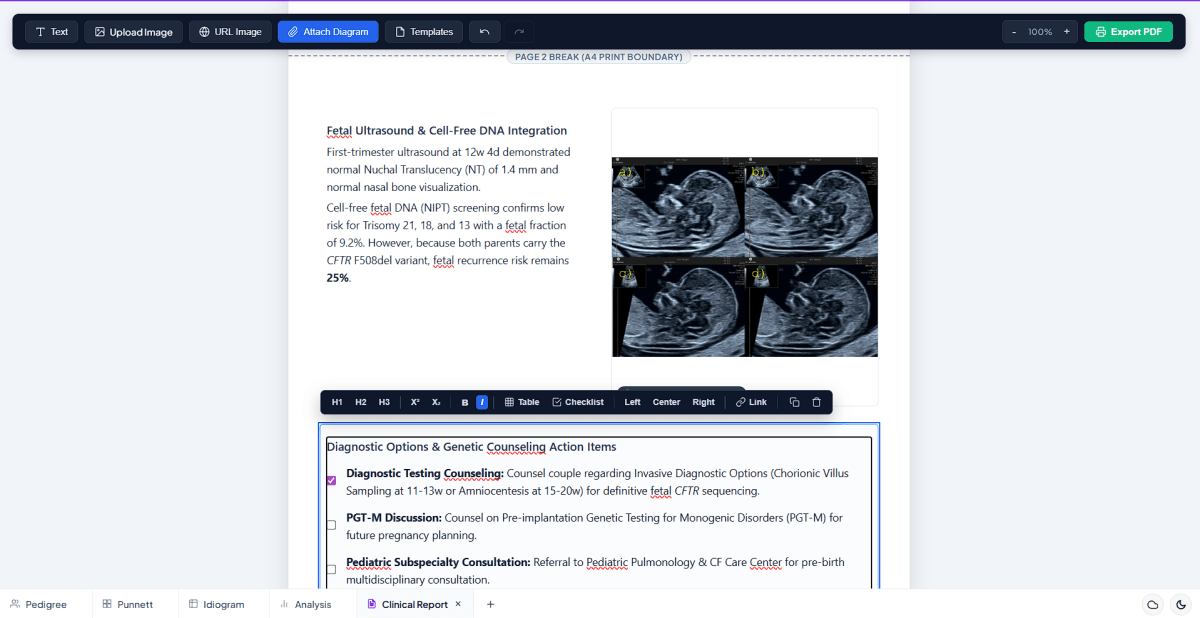
Biogistry solves these core clinical documentation challenges with a unified Free-Form Clinical Report Builder. Operating 100 percent locally within your web browser, our report builder combines a multi-page A4 freestyle canvas, an interactive rich-text editor with scientific genetics notation support, live vector diagram snapshot attachments, and dynamic @ mention patient variable auto-population.
Overcoming Clinical Genetics Documentation Pain Points
Legacy medical documentation systems were built for general clinical notes, not for the unique data structures of precision genomic medicine. Medical geneticists face systemic documentation hurdles every day:
1. Manual Copy-Paste Fatigue & Transcription Errors
When evaluating hereditary cancer or pediatric rare disease cases, clinicians calculate numerical risk scores across multiple tools (such as Gail BCRAT, Claus Model, or BRCAPRO). Manually typing patient demographics, allele designations, and calculated percentages into a word processor leads to frequent numerical keying errors that compromise patient care.
2. Static Diagram Immutability & Format Distortion
Pedigree charts and chromosome idiograms exported as raster JPEGs from external software blur when pasted into report documents. When a family tree changes during a consultation, clinicians must re-export the image, re-crop it, and re-insert it manually into their notes.
3. Missing Scientific & Genetics Typography
Standard web word processors lack native support for genetic scientific typography, including allele copy exponents (such as BRCA1+/-), chemical subscript notations, ACMG pathogenicity color-coding, and structured surveillance task checklists.
4. Rigid EHR Note Templates
Most Electronic Health Record (EHR) text boxes restrict layout formatting, preventing clinicians from arranging patient tables, IHC staining images, and multi-generational pedigree diagrams side by side.
5. Cloud Privacy & HIPAA Compliance Risks
Uploading patient consultation notes to cloud-hosted text editors or third-party AI writing assistants risks violating HIPAA rules and institutional governance policies.
Dynamic @Mention Patient Variable Auto-Population Engine
The centerpiece of Biogistry's Free-Form Clinical Report Builder is the Dynamic @ Mention Variable Engine. Instead of re-keying patient data, clinicians can reference any data point collected or computed within their active workspace session instantly.
How @Mention Auto-Population Works
Typing an @ symbol anywhere within a text block opens an interactive clinical variable dropdown menu. Clinicians can search and select any variable from across their active pedigree intake, risk models, Punnett square crosses, or chromosome idiogram sheets.
| Step | Action Taken by Clinician | System Automation & Result |
|---|---|---|
| 1. Trigger Menu | Type @ anywhere inside a report text block |
Opens interactive clinical variable selection popup menu |
| 2. Select Category | Choose Patient, Pedigree, Risk, Kinship, Variant, or Recurrence category | Filters workspace variables dynamically for single-click selection |
| 3. Insert Variable | Select desired clinical data item | Inserts live dynamic data field directly into report text |
Data Categories Referenced via @Mention
Clinicians can instantly reference all clinical data collected across their workspace by typing an @ symbol:
- Patient Demographics: Insert index proband or relative identification details, including full names, clinical aliases, medical record numbers, date of birth, age, and sex assigned at birth.
- Pedigree Family History: Reference total individual counts, affected family member tallies, multi-generational lineage tiers, and specific maternal or paternal branch histories.
- Calculated Cancer Risks: Insert calculated mathematical recurrence and penetrance percentages directly into clinical impression paragraphs and surveillance recommendations.
- Kinship & Consanguinity Metrics: Reference relationship coefficients, Wright's inbreeding coefficient (F), autozygosity values, and complex relationship parentage types.
- ACMG Molecular Variant Findings: Insert precise gene symbols, cDNA alteration strings, protein change designations, zygosity states, and ACMG pathogenicity classification tiers directly into diagnostic summaries.
- Mendelian Recurrence Probabilities: Auto-populate carrier likelihoods, offspring risk percentages, and Mendelian inheritance ratios derived from Punnett square cross matrices.
- Live Authoritative Database & API Search: Query authoritative genomic and medical reference databases live directly within the editor by typing
@followed by a search term. Search OMIM disease entries, Human Phenotype Ontology (HPO) clinical terms, Monarch Initiative genotype-phenotype correlations, Ensembl genomic locus coordinates, WHO ICD-11 diagnostic classifications, ClinVar variant records, and HGNC gene symbols, inserting validated clinical definitions and diagnostic codes into notes with a single click. - ISCN Cytogenetic Findings: Reference full ISCN karyotype strings, chromosomal band breakpoints, and copy number variation (CNV) genomic burden metrics.
Freestyle A4 Multi-Page Canvas
Biogistry moves beyond rigid single-column text fields by providing a Freestyle A4 Multi-Page Canvas. Clinicians can position text blocks, patient tables, diagnostic images, and vector diagram snapshots anywhere on the page with pixel-perfect control.
Fluid Multi-Page A4 Canvas Layouts
Elements on the canvas are positioned using proportional document scaling that adapts seamlessly across displays while maintaining exact A4 print proportions.
- Dynamic Page Expansion: As clinicians add findings or place blocks downward, the canvas automatically appends Page 2, Page 3, and subsequent pages with distinct visual A4 page-break margins.
- Responsive View Controls: Clinicians can adjust the canvas zoom scale slider from 50 percent to 150 percent to edit comfortably on laptop displays or review full desktop multi-page layouts.
- Precision Layering & Alignment: Intuitive drag-and-drop pointer controls allow clinicians to resize containers, adjust element layer ordering, duplicate blocks with a single click, and prevent visual label collisions.
Scientific & Clinical Rich-Text Editing Suite
The text editor inside Biogistry is designed specifically for medical and genetic documentation.
1. Genetics & Scientific Notation Stack
Standard text editors struggle with scientific formatting. Biogistry includes native support for:
- Allele Exponents (Superscript): Write precise genetic genotypes such as BRCA1+/-, XAXa, or TP53mut.
- Chemical & Biological Subscripts: Format molecular formulas like H2O, F1 generations, and Malécot kinship coefficients (φ12).
- Smart Typography: Automatic replacement of standard quotes with clean clinical typography and standardized dashes.
2. Clinical Findings Tables
Clinicians can insert resizable multi-column tables to summarize patient variant spectrums, biomarker panels, and laboratory results. Table headers, cell borders, background shading, and text alignment can be customized per report instance.
3. Interactive Surveillance Task Checklists
Post-test genetic counseling requires structured patient action plans. Clinicians can insert interactive task checklists to document surveillance schedules:
- Breast MRI screening every 6 months starting at age 25.
- Prophylactic bilateral salpingo-oophorectomy (BSO) consultation at age 35 to 40.
- Targeted single-site cascade variant testing for first-degree adult relatives.
4. ACMG Pathology Color Presets
Highlight critical variant findings with one click using American College of Medical Genetics and Genomics (ACMG) standardized color presets:
- Pathogenic (Class 5): High-priority red highlight for diagnostic pathogenic mutations.
- Likely Pathogenic (Class 4): Dark red highlight for likely disease-causing alterations.
- Variant of Uncertain Significance (VUS - Class 3): Amber yellow highlight for uncertain clinical significance.
- Likely Benign (Class 2) & Benign (Class 1): Soft green highlight for non-pathogenic variants.
Live Vector SVG Diagram Snapshot Attachments
A major advantage of Biogistry is its native integration across all clinical workbench tools. Clinicians can capture live, high-resolution vector SVG snapshots from active workspace sheets and embed them directly into report pages.
| Workspace Source Sheet | Attached Diagram Snapshot Artifact | Clinical Purpose in Progress Notes |
|---|---|---|
| Pedigree Chart Sheet | Multi-generational family tree diagram | Displays family history, carrier status, and inheritance patterns |
| Punnett Square Sheet | Mendelian cross matrix grid | Visualizes parental gamete segregation and fetal recurrence probability |
| Idiogram Karyotype Sheet | GRCh38 850-band chromosome map | Highlights cytogenetic bands, CNV boundaries, and pathogenic loci |
| Circos Genome Sheet | Circular genomic structural plot | Illustrates complex chromosomal translocations and gene fusions |
Every attached artifact maintains crisp vector scaling during PDF export, ensuring that labels, pedigree symbols, and cytobands remain perfectly sharp without pixelation.
Institutional White-Labeling & Custom Branding
Biogistry allows healthcare institutions, private genetics clinics, and independent counselors to brand their clinical reports completely.
White-Label Customization Capabilities:
- Hospital & Clinic Logo Upload: Upload high-resolution PNG or SVG clinic logos to display prominently on report headers.
- Locked Clinician Profiles: Synchronize clinician credentials (Name, Title, Primary Role, Medical License Number) across all report instances automatically.
- Custom Institutional Headers: Configure clinic address, telephone, email, and facility branding.
- Custom Letterhead PDF Exports: Generate progress notes that conform to hospital corporate communication guidelines for EHR inclusion and patient delivery.
5 Pre-Configured Multi-Page Clinical Templates
To accelerate documentation, Biogistry includes five multi-page report templates defined across major clinical genetics specialties. Clinicians can load a template with one click and customize all blocks.
| Clinical Specialty Domain | Template Name & Overview | Pre-Populated Report Components & Layout Structure |
|---|---|---|
| 1. Oncology | Hereditary Cancer Risk Report | • 2-Page A4 Layout for Breast, Ovarian, and Lynch consultations • Patient Referral Table & ACMG Variant Summary Table • Attached Pedigree & BRCA1 Idiogram Snapshots • Tumor IHC Staining Image & NCCN Surveillance Checklist |
| 2. Reproductive | Prenatal Carrier Screening Report | • 2-Page A4 Prenatal Carrier Screening Summary • Maternal/Paternal Demographics & Gestational Age • Autosomal Recessive Punnett Cross Matrix Snapshot • Carrier Lineage Pedigree & PGT-M Recommendation List |
| 3. Cytogenetics | Karyotype & Microarray Report | • 2-Page A4 ISCN Karyotype & Array CGH Report • ISCN 850-Band Chromosome Idiogram Snapshot • Sub-Megabase Microdeletion/Duplication Findings Table • ClinVar/OMIM Pathology Phenotype Mapping & Recommendations |
| 4. Cardiovascular | Cardiovascular Genetics Report | • 2-Page A4 Familial Hypercholesterolemia Summary • Lipid Profile Biomarker Tables & Cardiac MRI Images • Multi-Generational Sudden Cardiac Death Pedigree • Cascade Screening Protocol & Statin Action Checklist |
| 5. Metabolic | Inborn Errors of Metabolism | • 2-Page A4 Newborn Screening & Metabolic Consultation • Tandem Mass Spectrometry (MS/MS) Biomarker Table • Metabolic Pathway Diagram & Enzyme Activity Results • Emergency Dietary Management & Medical Formula Notes |
High-Quality Vector PDF Clinical Export
A clinical report builder is only as valuable as its document output. Biogistry focuses strictly on delivering high-quality, print-ready vector PDF progress notes engineered specifically for clinical documentation, patient delivery, and electronic health record (EHR) attachment.
Key Capabilities of High-Quality PDF Export:
- Vector Graphics Scaling: Attached pedigree trees, Punnett square matrices, 850-band chromosome idiograms, and Circos genome plots preserve full vector resolution during PDF rendering. Symbols, cytobands, and text callouts remain ultra-sharp without blurring or pixelation.
- A4 Page-Break Optimization: Intelligent document layout boundaries ensure page breaks occur cleanly between multi-page A4 sheets, preventing text blocks or diagnostic figures from splitting unnaturally across pages.
- White-Labeled Institutional Letterhead: Every exported PDF automatically formats your uploaded clinic logo, organization name, clinician credentials, contact information, and report date at the top of the note.
- Clinical Validation & Signature Lines: Exported progress notes include formal electronic signature lines for attending geneticists, confidentiality footers, and page-number indicators.
Real-World Clinical Use Cases
Use Case 1: Hereditary Cancer Risk Consultation
A genetic counselor evaluates a 38-year-old female with a strong maternal family history of early-onset breast cancer. Using Biogistry, the counselor draws a 3-generation pedigree, runs the Gail Model BCRAT calculation engine (yielding a 24.5 percent 5-year risk), and opens the Clinical Report Builder.
- The counselor selects the Hereditary Cancer Risk Template.
- Selecting patient demographics and calculated risk scores via the
@mention menu dynamically populates note text. - The counselor attaches a vector SVG snapshot of the family pedigree and exports a white-labeled PDF progress note for the patient's EHR record in under 3 minutes.
Use Case 2: Prenatal Carrier Screening & Fetal Risk Assessment
A maternal-fetal medicine specialist counsels a couple who are both heterozygous carriers of a pathogenic CFTR variant.
- The specialist loads the Reproductive Carrier Template.
- A live Punnett square cross matrix snapshot demonstrating the 25 percent recurrence risk is attached to Page 1.
- The specialist inserts an interactive task checklist outlining options for prenatal diagnosis (CVS/Amniocentesis) and PGT-M.
- The final report is printed directly to PDF with institutional branding.
Detailed Local Clinical Data Processing Summary Table
Biogistry processes 100 percent of clinical report layout calculations, text editing, variable auto-population, image compression, and document exports locally within your workstation's browser memory. No patient identifiers or consultation notes are uploaded to remote servers.
| Clinical Data Category | Specific Data Fields Processed Locally | Primary Clinical Purpose |
|---|---|---|
| Report Header Config | Organization name, clinician name, primary role, phone, email, report date, clinic logo image data | Rendering white-labeled institutional headers and letterheads. |
| Canvas Coordinates | Canvas block positions and layer ordering | Maintaining element positioning across A4 pages. |
| Editor State | Formatted text markup, heading tiers, bulleted lists, surveillance checklist item states | Storing formatted clinical findings and surveillance action plans. |
| @Mention Variable Tokens | @Mention patient & clinical data tokens | Resolving dynamic workspace data references into report text. |
| Vector SVG Snapshots | Vector diagram snapshot graphics, title, caption, timestamp | Embedding frozen diagram snapshots into report pages. |
| Compressed Media | Compressed diagnostic image data, domain origin, dimensions, alt text, caption | Displaying compressed diagnostic images (IHC, ECG, ultrasound). |
| Template Preset State | Template identifier, category, pre-populated element array, badge tags | Loading domain-specific multi-page report structures. |
| Undo / Redo History | Edit history stack | Enabling keyboard shortcut undo/redo. |
| Print Stylesheet State | A4 print layout configuration | Driving clean PDF print formatting. |
| Document Export State | Print-ready A4 document buffer, vector graphic rendering | Generating high-quality vector PDF progress notes for EHR attachment. |
Start Building White-Labeled Clinical Reports Today
Streamline your genetics documentation workflow with a fast, secure, and standardized online clinical report builder. Auto-populate patient variables with @ mentions, attach live pedigree snapshots, and export white-labeled PDF progress notes with complete confidence.