Complete Clinical Pedigree Chart Builder for Modern Healthcare
Drawing an accurate genetic pedigree chart is the foundation of clinical genetics, hereditary cancer screening, pediatric evaluations, and prenatal consultations. A detailed family pedigree tree allows genetic counselors, clinical geneticists, oncologists, and healthcare providers to visualize inheritance patterns, calculate familial recurrence risks, and make informed clinical recommendations.
Biogistry provides a comprehensive online pedigree chart generator designed specifically for clinical environments. Built to eliminate the delays and errors of manual paper charting, our pedigree builder allows you to map complex multi-generational family histories quickly during patient intakes.
Every pedigree diagram generated in Biogistry adheres to standardized recommendations established by the National Society of Genetic Counselors (NSGC) and the American College of Medical Genetics and Genomics (ACMG). From standard gender symbols to complex consanguineous relationship lines, our online pedigree chart maker ensures your documentation meets rigorous clinical standards for EHR integration, academic publications, and genetic risk assessment.
4 Pedigree Chart Layout Engines: Vertical, Radial, Horizontal & Crop-Net
Visualizing complex genetic trees across multi-generational families requires layout engines tailored to different clinical scenarios. Biogistry supports four distinct graph layout rendering algorithms: Vertical Standard Layout, Radial Consanguineous Layout, Horizontal Linear Layout, and Crop-Net Subgraph Layout. Clinicians can toggle between layout engines instantaneously with zero data loss.
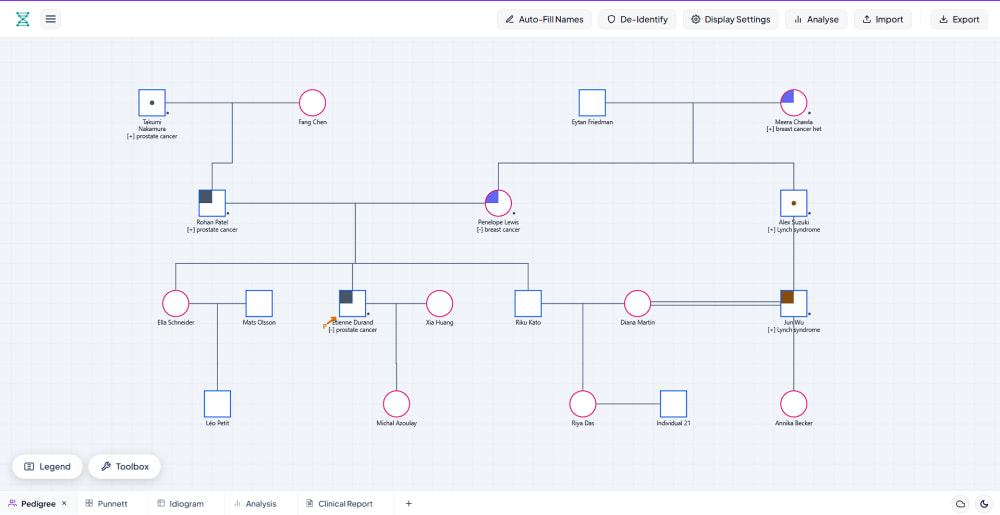
1. Vertical Standard Layout (ACMG & NSGC Clinical Default)
The Vertical Standard Layout is the traditional top-to-bottom generational hierarchy recommended by the American College of Medical Genetics and Genomics (ACMG) and National Society of Genetic Counselors (NSGC).
- Visual Architecture: Arranges founder generations on upper tiers, with children dropping down vertically via partner connection bars and offspring branch lines.
- Primary Clinical Utility: Recommended default for standard three-to-four generation clinical genetic counseling intakes, hereditary cancer consultations, and routine electronic health record (EHR) documentation.
- Best Used When:
- Conducting standard 3-generation hereditary cancer or cardiovascular risk intakes.
- Documenting clear parent-to-child allele transmission without inter-family loops.
- Generating publication-ready clinical summaries for patient charts.
2. Radial Layout (Consanguinity & Inbreeding Autozygosity Focus)
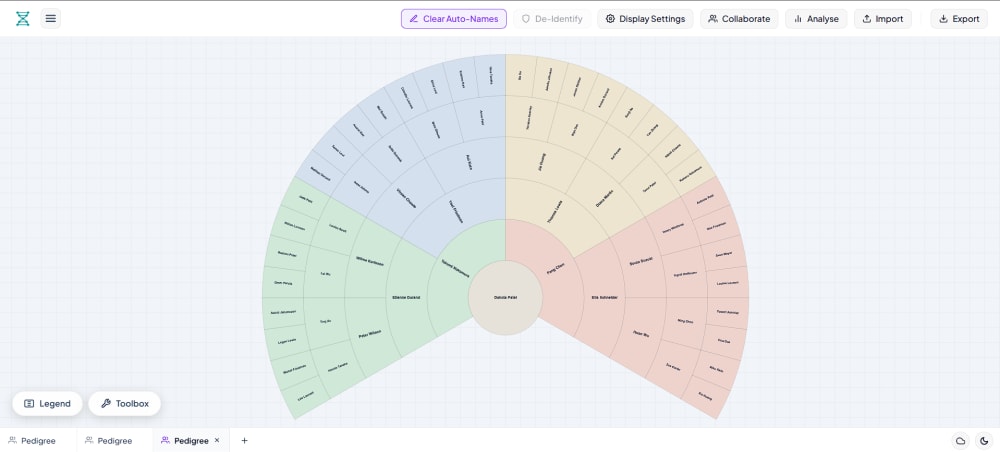
The Radial Layout Engine organizes family members in concentric rings around a central proband couple or founder ancestor.
- Visual Architecture: Positions the index proband couple or central ancestor at the origin, with ancestral and collateral relationship tiers expanding outwards in concentric circles.
- Primary Clinical Utility: Specially designed for analyzing complex consanguineous unions, first-cousin or second-cousin marriages, autozygosity mapping, and calculating Wright's Coefficient of Inbreeding (F) and Malécot Kinship Coefficient (φ).
- Best Used When:
- Evaluating consanguineous marriages where traditional vertical layout lines cross excessively.
- Calculating autozygous recessive risk vectors in endogamous or isolated populations.
- Visualizing multi-loop consanguinity without cluttered visual line crossings.
3. Horizontal Linear Layout (Timeline & Sequential Inheritance Flow)
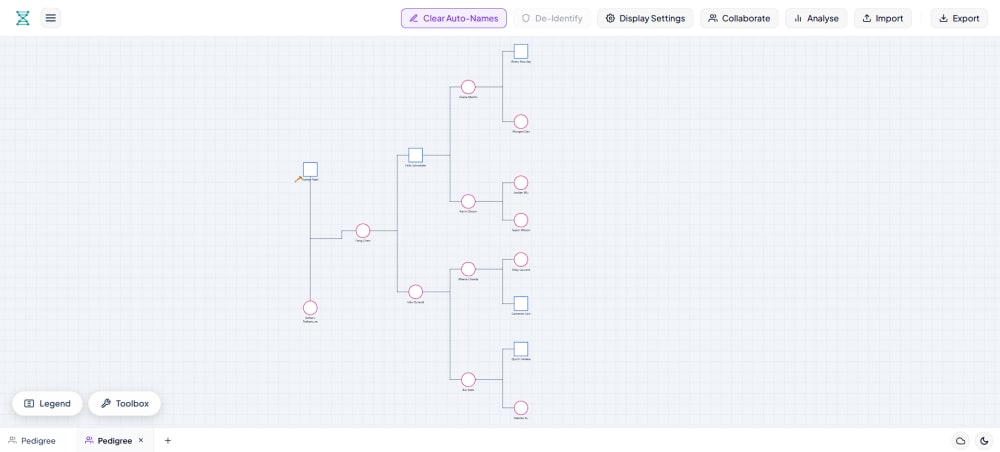
The Horizontal Linear Layout flips the generational axis to flow horizontally from left to right.
- Visual Architecture: Maps the oldest ancestor generation on the far left, extending offspring and subsequent generations sequentially towards the right.
- Primary Clinical Utility: Ideal for ultra-wide desktop monitors, landscape PDF report exports, chronological disease onset timeline tracking, and educational presentations.
- Best Used When:
- Presenting family health history across ultra-wide clinical workstations or dual-monitor setups.
- Tracking age-dependent disease onset (such as Huntington's disease or familial Alzheimer's) sequentially over time.
- Exporting wide-format landscape PDF summaries for clinical conferences or journal figures.
4. Crop-Net Subgraph Layout (Dense Subgraph Isolation & Registry Focus)
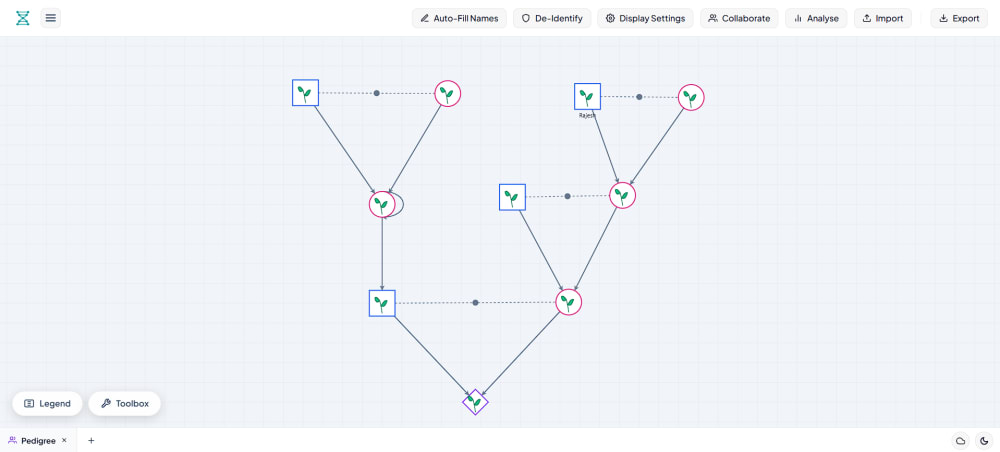
The Crop-Net Subgraph Layout is an advanced subgraph extraction algorithm designed for large extended registries.
- Visual Architecture: Dynamically isolates a targeted sub-branch or disease-affected kindred from large multi-generational pedigree graphs while preserving topological connection indicators.
- Primary Clinical Utility: Enables clinicians to zoom into specific high-risk cancer clusters or maternal/paternal branches out of massive 50+ to 200+ individual family registries.
- Best Used When:
- Managing large multi-generational hereditary disease registries (e.g., Lynch Syndrome or Li-Fraumeni extended families).
- Focusing patient consultations on a specific affected lineage without screen clutter from distant unaffected branches.
- Conducting targeted sub-pedigree risk modeling on complex extended kindreds.
Single Intake Architecture: Zero Double Data Entry
One of the biggest challenges in legacy genetic software is the frustration of entering patient data multiple times across different calculation tools, risk worksheets, and clinical report templates. Biogistry solves this problem with a unified single intake architecture.
How Single Intake Works
- Build Your Pedigree Intake: As you record patient history during a consultation, enter demographic details, diagnoses, ages of onset, and genetic test results directly onto the pedigree chart using the interactive inspector.
- Instant Workspace Synchronization: The moment an individual node is created or updated, your pedigree intake automatically synchronizes across all connected tools in your active session.
- Zero Manual Rekeying: Connected risk calculation models, carrier screening worksheets, Punnett square allele derivation panels, and clinical progress notes read directly from the pedigree tree.
If you update a relative's cancer diagnosis or age of onset on the pedigree diagram, all connected risk scores and clinical summaries recalculate instantaneously. This eliminates human transcription errors, accelerates consultation documentation, and saves valuable clinical time.
Comprehensive Pedigree Builder Canvas Features
The Biogistry pedigree builder canvas provides a powerful set of drawing, editing, and formatting controls designed for high-volume clinical workflows. Whether you are mapping a simple three-generation family tree or a complex multi-lineage kindred, the canvas delivers total precision.
History and Editing Controls
- Undo and Redo History: Complete edit history allows you to revert changes or reapply modifications with confidence during live patient interviews.
- Quick Fill Fake Name Generator: Protect patient privacy during screen sharing, clinical teaching, or presentations. One click generates realistic placeholder names across the entire family tree while preserving all clinical diagnoses and relationship structures.
- One-Click PHI De-Identification: Anonymize pedigree charts instantly for research publications, clinical trials, or external consultations. Patient names and MRN identifiers are replaced with secure randomized codes while maintaining complete genetic pedigree topology.
Canvas Annotations and Visual Display Controls
- Interactive Canvas Notes: Place freeform clinical annotations, diagnostic notes, or risk callout boxes directly anywhere on the canvas grid. Connect notes to specific individuals using visual connector lines.
- Smooth Pan and Zoom Navigation: Intuitively pan across expansive multi-generational family trees and zoom into specific sub-lineages or sibling clusters with complete clarity.
- Unused Branch Fade Out: Focus your clinical review on relevant disease branches. Visual display settings allow you to fade out unaffected family branches or highlight specific inherited conditions.
- Custom Display Settings: Toggle node label visibility, customize symbol dimensions, adjust relationship line thickness, show or hide age callouts, and display individual clinical tags directly on the pedigree chart diagram.
- Dark Mode & Clinical Light Theme: Switch seamlessly between high-contrast dark mode and crisp clinical light mode to reduce visual fatigue during low-light consultations.
- Local Folder Data Sync: Select a custom local folder on your machine via File System Access API to automatically sync, save, and back up your pedigree workspace locally with zero cloud transmission.
Support for Traditional and Modern Family Structures
Family structures in modern clinical medicine extend far beyond traditional biological pedigree models. Biogistry includes native support for both traditional family relationships and modern assisted reproductive technology parentage structures.
Standard Biological Relationships
- Marriages and Partners: Standard horizontal relationship lines connecting male, female, or non-binary partner symbols.
- Consanguineous Unions: Document consanguinity with standard double horizontal relationship lines between related individuals. The system automatically highlights consanguineous loops for inbreeding coefficient evaluation.
- Divorced and Separated Partners: Display relationship dissolution with standard diagonal strike lines across partner connection bars.
- Offspring Lineage: Vertical and horizontal child distribution lines connecting parents to multi-generational offspring tiers.
Assisted Reproduction and Modern Parentage
- Adoptive Relationships: Clearly distinguish legal adoption status on the pedigree chart. Adopted In individuals are rendered with square brackets and dashed parentage lines. Adopted Out individuals display square brackets with solid biological connection lines.
- Single Parent Relationships: Create single parent offspring nodes directly without requiring dummy or unknown partner symbols on the chart.
- Sperm and Egg Donors: Assign anonymous or identified sperm donors and egg donors to offspring nodes. Donor relationships maintain proper genetic tracking while accurately reflecting family legal structure.
- Surrogacy Arrangements: Full support for both gestational surrogacy (where the surrogate carries an embryo created from intended parents or donors) and traditional surrogacy (where the surrogate is biologically related to the child).
- Same-Sex Unions and Non-Binary Parentage: Document same-sex couples, non-binary individuals, and gender-affirming parentage while maintaining clear tracking of biological gamete sources.
- Twin Branches: Map identical monozygotic twins (connected with a triangular junction bar and horizontal connecting line), fraternal dizygotic twins (triangular junction bar without horizontal line), and twins of unknown zygosity.
Detailed Local Clinical Data Collection Overview
Biogistry allows healthcare providers to record granular clinical details for every individual in a pedigree tree. All collected data is processed and stored 100% locally on your computer with zero transmission to cloud servers.
Information Collected Locally Per Individual Node
| Clinical Data Category | Specific Information Fields Collected | Primary Clinical Purpose |
|---|---|---|
| Individual Identity | Full name, clinical alias, medical record number (MRN), proband status, consultand flag, image attachments | Patient identification, pedigree indexing, and index case tracking |
| Demographics & Ancestry | Sex assigned at birth, gender identity, date of birth, age, ethnicity, Ashkenazi Jewish ancestry, nationality | Baseline demographic risk stratification and population carrier risk evaluation |
| Vital Status & Mortality | Alive flag, deceased indicator, year of death, cause of death (WHO ICD-11 search), MONDO mapping | Mortality analysis, survival curves, and familial cause of death tracking |
| Testing Availability | Unavailable for testing indicator (estranged, refused testing, or lost to follow-up) | Qualifies unaffected probands for cascade testing under NCCN guidelines |
| Reproductive & Pregnancy | Active pregnancy flag, gestational age, karyotype string, LMP date, stillbirth, SAB, TOP, fetal anomalies | Obstetric history, prenatal screening, and fetal anomaly tracking |
| Clinical Examination | Examined status toggle, age at clinical examination, examination outcome notes | Clinical genetics physical evaluation tracking |
| Breast Cancer Risk Profile | Height, weight, calculated BMI, age at menarche, parity, age at first live birth, menopause status and age | Essential clinical inputs for Gail BCRAT and Tyrer-Cuzick IBIS risk assessment |
| Hormone Therapy History | HRT usage type (estrogen only, combined), HRT user status (current/former), duration in years | Endogenous and exogenous hormonal exposure evaluation |
| Breast Pathology & Density | Number of previous breast biopsies, biopsy findings (hyperplasia, ADH/ALH, LCIS), BI-RADS breast density | Histologic risk modifier recording and mammographic density tracking |
| Pancreatic Risk Profile | Smoking status (never, former, current), history of chronic pancreatitis, type 2 diabetes and duration | Modifiable risk factor inputs for PancPRO pancreatic cancer risk scoring |
| Parentage & Lineage | Biological mother, biological father, adoption status, single parent mode, donor type, surrogate role, twin zygosity | Precise genetic relationship tree mapping and kinship calculation |
| Gamete Donor History | Donor family history status (unknown, limited, complete), sperm donor ID, egg donor ID | Genetic tracking for assisted reproduction and donor conception |
| Surrogacy Management | Surrogacy role (gestational carrier vs traditional surrogate), linked surrogate mother ID | Legal parentage distinction and surrogate lineage connection |
| Union & Marriage History | Partner IDs, union type (married, unmarried, divorced, consanguineous), marriage year, divorce year | Family union tracking and consanguinity coefficient calculation |
| Clinical Diagnoses | Primary conditions, secondary diagnoses, age of onset, diagnosis year, phenocopy flag | Hereditary disease pattern tracking and penetrance evaluation |
| Standardized Ontologies | Monarch MONDO disease IDs, OMIM IDs, WHO ICD-11 codes, Human Phenotype Ontology (HPO) terms | Integration with standardized clinical medical vocabularies |
| Genetics & Molecular | Tested gene panels, specific variant nomenclature, zygosity status, test result status, ClinVar links | Molecular diagnostic tracking and carrier risk determination |
| Testing Method & Sensitivity | Test type (Panel, Single Gene, WES, WGS, Karyotype, Microarray, Methylation), test lab, test date, sensitivity | Genotype confidence assignment and Bayesian posterior likelihood calculation |
| Genotype Confidence | Tested-noncarrier, tested-carrier, tested-affected, phenotype-only, unknown | High-precision pedigree peeling and Bayesian matrix construction |
| Repeat Expansions | Tri-nucleotide repeat lengths (CAG count for Huntington's, CTG count for DM1, CGG for Fragile X), onset regressions | Exact age of onset calculation for trinucleotide repeat disorders |
| Lynch & Biomarker Pathology | MMR status (dMMR/pMMR), MSI status (MSI-High/MSS), BRAF V600E mutation, MLH1 hypermethylation | Tumor biomarker recording for Lynch syndrome screening algorithms |
| Cancer Pathology Details | Breast cancer subtype (TNBC, ER+, HER2+), ovarian histology, prostate risk group & Gleason score | Pathology-level classification for NCCN referral criteria evaluation |
| Bayesian Penetrance | Penetrance model (full, reduced, age-dependent), lifetime penetrance, median onset age, onset std dev | Mathematical penetrance curve modeling for Bayesian risk calculation |
| Diagram Formatting | Quadrant symbol shading colors, symbol fill patterns, condition abbreviations, display label preferences | ACMG compliant pedigree diagram rendering and visual legend generation |
Deep Dive: The 3 Core Pedigree Node Inspector Tabs
When you click on any individual symbol in the pedigree builder canvas, the Node Inspector opens to provide complete control over that person's clinical profile. The inspector is organized into three dedicated tabs designed specifically for pedigree charting.
1. Basic Details Tab
The Basic Details tab establishes individual identity, demographic parameters, vital clinical status, reproductive history, and comprehensive breast cancer risk factors:
- Patient Name, Clinical Alias, and Node Image Attachments: Record official names, medical record numbers, and clinical aliases. Upload custom node images or clinical photos directly to individual profiles.
- Sex Assigned at Birth and Gender Identity: Select sex assigned at birth (Male square, Female circle, or Unknown/Unspecified diamond) to control primary ACMG symbol rendering. Record gender identity independently to maintain respectful patient documentation.
- Race, Ethnicity, and Ashkenazi Jewish Ancestry: Record patient ethnicity and Ashkenazi Jewish ancestry flags. This information is critical for population carrier frequency adjustments and founder mutation screening recommendations.
- Nationality and Flag Mapping: Search and select nationality with automatic flag icon rendering for international clinical consultations.
- Proband and Consultand Designations: Set the proband flag to automatically render a prominent arrow pointing directly to the index patient on the pedigree chart. Tag consultands seeking genetic counseling.
- Vital Status and Cause of Death Search: Toggle between Alive and Deceased status. For deceased individuals, entering a year of death automatically renders a standard diagonal slash through the symbol. Search WHO ICD-11 codes directly to assign precise cause of death titles and MONDO ontology mappings.
- Unavailable for Testing Flag: Mark living relatives who are estranged, refused testing, or lost to follow-up. Tagging unavailable relatives helps justify cascade genetic testing for unaffected probands under NCCN clinical guidelines.
- Reproductive and Pregnancy Tracking: Record active pregnancies, gestational age in weeks, karyotype results (such as 47,XX,+21), and last menstrual period (LMP) dates. Document stillbirths, spontaneous abortions (miscarriage / SAB), or terminations of pregnancy (TOP). Search and attach identified fetal anomalies from the Monarch HPO disease registry.
- Clinical Examination Status: Record whether an individual has undergone a physical clinical examination, age at examination, and specific outcome notes.
Breast Cancer Risk Factors (Gail Model and Tyrer-Cuzick Inputs)
The Basic Details tab collects a complete battery of clinical inputs required for breast cancer risk evaluation:
- Anthropometric Data: Record height in centimeters and weight in kilograms to automatically calculate Body Mass Index (BMI).
- Reproductive Factors: Record age at menarche (first menstrual period), total parity (number of children), and age at first live birth.
- Menopause Status: Record postmenopausal status and exact age at menopause onset.
- Hormone Replacement Therapy (HRT): Select HRT usage patterns including Never Used, Current User (Estrogen Only), Current User (Combined Estrogen and Progesterone), Former User (Estrogen Only), or Former User (Combined). Record total HRT duration in years.
- Breast Biopsy History: Record the number of previous benign breast biopsies (0, 1, or 2+ biopsies).
- Biopsy Pathology Findings: Document specific histologic biopsy results, including No Hyperplasia, Proliferative Disease Without Atypia, Atypical Ductal or Lobular Hyperplasia (ADH/ALH), or Lobular Carcinoma in Situ (LCIS).
- Mammographic Breast Density: Select BI-RADS breast density classifications: BI-RADS A (almost entirely fatty), BI-RADS B (scattered fibroglandular densities), BI-RADS C (heterogeneously dense), or BI-RADS D (extremely dense).
Pancreatic Risk Factors (PancPRO Inputs)
- Smoking Status: Record smoking history as Never Smoker, Former Smoker, or Current Smoker.
- Pancreatitis and Diabetes: Document history of chronic pancreatitis, Type 2 Diabetes Mellitus diagnosis, and total diabetes duration in years.
2. Parentage Tab
The Parentage tab provides complete control over biological relationships, adoption status, assisted reproductive technology (ART), gamete donor tracking, surrogacy arrangements, and partner marriage timelines:
- Biological Parent Assignments: Select biological mother and father from existing individuals on the canvas or create new parent nodes with a single click.
- Adoption Status Configuration: Select from Biological Child (standard solid parentage line), Adopted In (renders square brackets
[]around the symbol with a dashed connection line to adoptive parents), or Adopted Out (renders square brackets[]with a solid line to biological parents). - Single Parent Mode: Toggle Single Parent (No Partner) status for any relationship. This hides unnecessary dummy partner symbols and drops the child descent line directly from the single parent.
- Gamete Donor Settings and Donor History:
- Mark any individual as a Gamete Donor (applies directly to the donor's symbol).
- Record Donor Family History Status: Unknown, Limited, or Provided/Complete.
- Link or create Sperm Donors (male/unspecified) or Egg Donors (female) for offspring nodes to track biological gamete sources without cluttering partner lines.
- Assisted Reproduction and Surrogacy Management:
- Gestational Carrier mode: For couples whose gametes are used to impregnate a surrogate mother who carries the pregnancy.
- Traditional Surrogate mode: For arrangements where the surrogate's own egg is fertilized by the intended father's or donor's sperm.
- Declare any existing female or non-binary individual on the canvas as a surrogate mother or create a dedicated new surrogate node.
- Manage linked surrogate mother assignments with 1-click updates.
- Relationships and Marriage Timelines:
- View all partner unions linked to an individual.
- Configure union status as Married, Unmarried, Divorced/Separated (renders a diagonal strike line across the relationship line), or Consanguineous (renders double horizontal lines indicating shared ancestry).
- Record exact Marriage Year (start year) and Divorce/Separation Year (end year) for clinical record completeness.
- Twin Zygosity Classification: Connect siblings as identical monozygotic twins (renders a triangular branch with a horizontal connecting bar), fraternal dizygotic twins (renders a triangular branch without a horizontal bar), or twins of unknown zygosity.
3. Conditions & Genotype Tab
The Conditions & Genotype tab allows clinicians to record multi-condition disease histories, standardized ontologies, molecular genetic test results, tumor biomarkers, pathology details, and Bayesian penetrance parameters:
- Multi-Condition Diagnosis Tracking: Record multiple medical conditions, cancers, or genetic syndromes per individual.
- Disease Ontology & Search: Live search across Monarch Initiative, MONDO disease IDs, OMIM IDs, WHO ICD-11 / ICD-10 codes, and custom condition names. Automatic disease classification and inheritance pattern auto-population (Autosomal Dominant, Autosomal Recessive, X-Linked Recessive, X-Linked Dominant, Y-Linked, Mitochondrial).
- ACMG Quadrant Symbol Shading & Color Picker: Assign custom colors to up to four distinct disease conditions per person. The pedigree canvas automatically renders proportional quadrant shading (top left, top right, bottom left, bottom right) on the individual's symbol. Set condition abbreviations (such as "Br" for Breast Cancer or "CRC" for Colorectal) displayed directly on the diagram.
- Phenocopy Flag: Distinguish sporadic phenocopies from germline inherited disease cases for precise Bayesian recurrence risk modeling.
- Human Phenotype Ontology (HPO) Search: Search and attach standardized HPO terms (such as microcephaly, cardiomyopathy, or colonic polyps) with automated disease-phenotype suggestions and verification tags.
- Comprehensive Genetic Test Recording:
- Record whether genetic testing was performed.
- Select Test Type: Gene Panel, Single Gene, Whole Exome Sequencing (WES), Whole Genome Sequencing (WGS), Karyotype, Chromosomal Microarray (CMA), RNA Sequencing, Methylation, or Other.
- Record Test Result Status: Positive, Negative, Variant of Uncertain Significance (VUS), Inconclusive/Uncertain, or Pending.
- Automatic Test Sensitivity calculation (such as 0.99 for single gene, 0.95 for gene panels/WES, 0.98 for WGS, or 0.20 for WES/WGS on repeat expansions).
- Record Testing Laboratory, Test Date, Test Notes, and Genotype Confidence tier (tested-noncarrier, tested-carrier, tested-affected, phenotype-only, unknown).
- Gene & ClinVar Variant Tracking:
- Search and select Gene Symbols (such as BRCA1, BRCA2, PALB2, MLH1, MSH2, MSH6, PMS2, TP53, HTT, FMR1, VHL, NF1, CFTR, PMP22, FBN1).
- Search ClinVar variants in real-time with HGVS cDNA/protein nomenclature, ClinVar accession numbers, and clinical significance classifications (Pathogenic, Likely Pathogenic, VUS, Benign).
- Select Zygosity: Heterozygous, Hemizygous, Biallelic/Homozygous, or None.
- Trinucleotide Repeat Lengths: Record repeat counts for expansion disorders (such as CAG repeat count for Huntington's disease, CTG count for Myotonic Dystrophy DM1, or CGG count for Fragile X). Automatically calculates age-onset regressions (such as Langbehn HD regression or DM1 CTG onset curves).
- Tumor Biomarkers and Lynch Syndrome Screening:
- Mismatch Repair (MMR) Immunohistochemistry status: dMMR (deficient - loss of MLH1, MSH2, MSH6, PMS2), pMMR (proficient), or Untested.
- Microsatellite Instability (MSI) status: MSI-High, MSI-Low, MSS (Stable), or Untested.
- BRAF V600E Mutation status: V600E Mutant, Wildtype, or Untested.
- MLH1 Promoter Hypermethylation status.
- Polyposis polyp counts and types (Adenomatous, Hamartomatous, Juvenile, Serrated).
- Cancer Histology & Pathology Subtypes:
- Breast cancer receptor status: Triple-Negative (TNBC), ER+, HER2+. Bilateral breast cancer indicators (synchronous/metachronous) and male breast cancer flags.
- Ovarian cancer histology: Epithelial Serous (high-grade serous), Endometrioid, Clear Cell, Mucinous, Non-Epithelial.
- Pancreatic cancer histology: Exocrine (ductal adenocarcinoma), Acinar cell, Neuroendocrine.
- Prostate cancer risk groups (Low, Intermediate, High, Very High, Metastatic), Histology (Adenocarcinoma, Intraductal, Cribriform), and Gleason scores.
- PARP Inhibitor candidacy tagging.
- Bayesian Penetrance Parameters:
- Select Penetrance Model: Full penetrance (100% constant), Reduced penetrance (constant fraction), or Age-dependent cumulative penetrance (sigmoid hazard curves).
- Select Disease Presets: BRCA1 (75% lifetime), BRCA2 (69% lifetime), PALB2 (53%), Lynch MLH1/MSH2 (80%), Lynch MSH6 (50%), Lynch PMS2 (30%), Huntington's (100%), Fragile X (47% male / 16% female), VHL (90%), NF1 (100%), Cystic Fibrosis (100%), HNPP (80%), Marfan (100%).
- Configure custom median age of onset, standard deviation, and lifetime cumulative penetrance values.
High-Level Mentions: Workspace Integrations and Security
While the pedigree chart builder forms the core of your clinical intake, it connects seamlessly with broader workspace tools and security features.
Direct Access to Risk Calculation Models
Without re-entering patient data, your completed pedigree tree can be evaluated against validated clinical risk models directly from the workspace. Assess hereditary breast and ovarian cancer risks, Lynch syndrome probabilities, and autosomal recessive carrier frequencies using your active pedigree intake data.
Multi-Format Document Export
Export your completed pedigree chart in multiple publication-ready and clinical formats. Generate vector PDF clinical summaries complete with patient legend keys, download high-resolution PNG or SVG images for presentations, or export standard GEDCOM 5.5.1 and SMART on FHIR R4 Bundle files for EHR integration.
Client-Side Encryption and Real-Time Collaboration
Collaborate safely with colleagues on complex pedigree cases. Biogistry supports zero-knowledge, client-side encrypted real-time collaboration. Share active sessions with team members using end-to-end encrypted room keys where patient data remains encrypted in transit and at rest.
Start Building Standardized Pedigree Charts Online Today
Streamline your clinical genetics intake with a fast, private, and standardized online pedigree chart maker. Map multi-generational family health histories, record granular patient phenotypes, and export publication ready pedigree diagrams with complete confidence.
Launch Pedigree Builder Workbench or Try Free Online Builder (No Registration Required)